If a Breach Happened Today, How Fast Would You Know?
Understanding Managed Detection and Response (MDR) for Modern Leaders
Most leaders looking into their company's security infrastructure have been arriving at the same sobering realization: the tools are deployed, the dashboards look stable, the SOC is running smoothly, and yet, something feels fragile.
Meanwhile, alerts keep arriving, analysts are worn out, the board is asking sharper questions, and you’re not entirely certain how quickly your organization would detect a sophisticated lateral movement attack.
Over the last decade, organizations have poured investments into EDR, SIEM, and cloud security platforms. But while visibility increased, so did complexity, leaving teams more overwhelmed than protected.
According to Palo Alto Networks’ Unit 42 research, attackers in many incidents now move from initial compromise to data exfiltration in less than a day, and sometimes in under an hour.
Meanwhile, IBM’s Cost of a Data Breach Report continues to show that longer detection times significantly increase total breach cost.
Speed is now the defining variable. The question is no longer whether you receive alerts; it’s whether you can outpace the attacker.
What Is MDR in Cybersecurity: From a Leadership Perspective
Formally, Managed Detection and Response (MDR) combines advanced detection technology, automation, threat intelligence, and human expertise to continuously detect and respond to threats.
From a leadership standpoint, it means something more practical:
MDR is an operational layer designed to reduce attacker dwell time without forcing you to scale headcount at the same pace as risk.
It connects telemetry across endpoint, cloud, identity, and network. It automates triage before analysts engage. And ensures real threats receive expert investigation, quickly.
When executed well, MDR shifts security from reactive monitoring to controlled response.
Why Leaders Start Exploring MDR
The trigger isn’t curiosity. It’s friction.
Alert fatigue is affecting performance.
False positives are draining resources.
Correlating data across environments feels manual.
Regulatory pressure is increasing
Demonstrating ROI to the board is difficult.
The team works hard. The tools are strong. Nevertheless, operational scale hasn’t kept up with attacker speed.
There's a question that keeps CISOs up at night: If a breach occurred today, how quickly would you know about it, and how much damage would be done before you could act?
MDR vs SOC: The Maturity Question
The debate around MDR and SOC is often framed as one of outsourcing. That misses the point.
A SOC is a team structure, while MDR is an operating model.
Maintaining a high-performing SOC requires continuous detection tuning, automation engineering, threat intelligence integration, and 24/7 coverage without burnout.
Some organizations can achieve that level of maturity internally. However, many cannot, not due to a lack of talent, but rather because achieving operational excellence on a large scale is resource-intensive.
MDR enhances this capability by providing structured automation and integrated investigation, eliminating the need for additional resources to handle escalations.
Want to see what a modern SOC should look like?
Many organizations don’t need to replace their SOC, they need to evolve it.
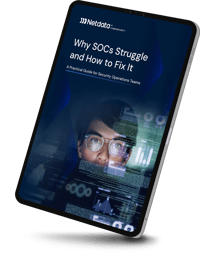
In our latest guide, Why SOCs Struggle and How to Fix It, we break down the operational gaps that prevent security teams from reaching true MDR-level maturity.
Traditional MSSPs monitor and escalate alerts, while MDR actively investigates, hunts, and responds. That difference matters because monitoring alone does not reduce dwell time. Response velocity does.
For modern leaders, the distinction is simple: monitoring informs, response protects.
What Problems Does MDR Actually Solve?
At its core, MDR addresses systemic operational weaknesses:
It reduces alert overload through automation.
It accelerates detection and containment timelines.
It integrates fragmented security telemetry.
It relieves talent pressure without sacrificing 24/7 coverage.
The real MDR benefits are measurable outcomes:
Faster containment of material threats.
Reduced operational strain on internal teams.
Clearer executive reporting.
More predictable security performance.
For leaders, predictability is power.
When Does MDR Fail?
Not all MDR services are equal. MDR fails when it behaves like outsourced alert forwarding, when automation is superficial, when detection logic is static, and/or when response authority is unclear.
If the service does not materially improve detection speed, reduce noise, and provide executive-level clarity, it is not delivering true MDR value.
Modern leaders should evaluate MDR providers with discipline:
How much triage is automated before human review?
How is detection logic continuously refined?
What is the real-world detection-to-containment time?
How is business risk reported at the executive level?
Final Thought
MDR is more than a compliance requirement, it is a fundamental choice in how you master speed and manage risk in an uncertain environment.
The question is no longer:
Do we have coverage?
But rather:
Can we detect, investigate, and contain threats at the pace modern attacks require?
At Netdata, we work with organizations that already have strong tools and capable teams.
However, they need a more integrated, automation-driven detection model that scales without adding operational strain.
In today’s threat landscape, visibility is only the baseline. True resilience is forged through coordinated action.
Uncertain if your security operations can keep pace?
Let’s assess your detection and response maturity to identify the specific gaps where risk is quietly accumulating.
It is recognized as one of the best cybersecurity service partners worldwide by leading manufacturers in the market. Its talented team supports a wide range of security services.